
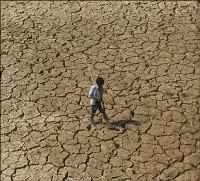
 Although drought threatens to eat into India's food production, the government has enough food stocks to feed the country's one billion-plus population for nearly three months in the event of any contingency.
According to the official data, the Centre has 50.4 million tonnes of food grains -- 18.79 million tonnes of rice and 31.62 million tonnes of wheat -- in its granaries as of July end.
Since India consumed 219 million tonnes of foodgrains in 2008-09, as stated by Food and Agriculture Minister Sharad Pawar in the Lok Sabha last month, the country may need about 221.3 million tonnes of rice and wheat this year, accounting for a slight increase in population from about 114.79 crore (Rs 1.14 billion) last year.
If consumption this year remains at the level of 2008-09 when rainfall was fairly better leading to higher supply of food grains in the market, the government can still feed the entire country for a good 82 days.
While the Food Corporation of India has built a stock of 14.14 million tonnes of rice and 10.34 million tonnes of wheat, different state agencies have built reserves of 4.64 million tonnes of rice and 21.27 million tonnes of wheat, the data showed.
The current reserves have far exceeded the government's buffer norms according to which the country needs to keep foodgrain stocks of at least 26.9 million tonnes till July 1 and 16.2 million tonnes by October 1.
The huge stocks are the result of an all-time-high procurement of the foodgrains this year.
Moreover, the large stocks seem to bolster the Centre's initiative to fight back the menace of poor monsoon, which was evident from Pawar's statement in Parliament that India has enough foodgrains to meet requirement under the public distribution system and some other welfare programmes for as long as 13 months.
Not just Pawar, even Finance Minister Pranab Mukherjee said earlier this week that it was not yet time to 'press the panic button' on the impact of monsoon.
"This country has the experience of handling the situation (drought) and I will advice not to press the panic button," Mukherjee said, maintaining, however, that the deficient monsoon would result in a 20 per cent decline of the sowing of summer crops.
Earlier this week, the meteorology department forecast that this season's monsoon may bring only 87 per cent of the usual rains.
Nevertheless, the huge reserves are expected to provide some cushion against the dampening impact of the poor monsoon.
India produced 99.15 million tonnes of rice and 80.58 million tonnes of wheat last year, paving the way for record procurement by the government at about 57.6 million tonnes of both the grains.






 © 2025