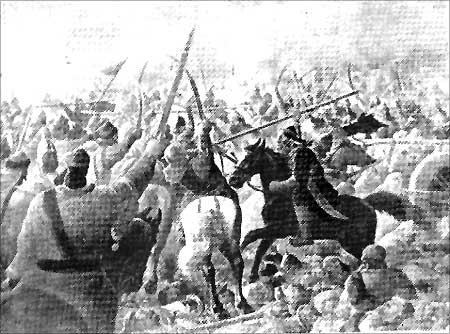
The Marathas and the Afghans prepared their armies for a major battle, but waited as the Afghans didn't want to attack first and the Marathas were waiting for reinforcements to arrive.
Eventually, the deteriorating situation forced the Marathas to attack the Afghans before their reinforcements arrived. The Marathas had better French guns and made significant progress. Ibrahim Gardi played a key role in getting early breakthroughs for the Marathas.
By noon, it appeared that the Marathas would win.
Faced with imminent defeat, Abdali called on his highly trained reserve soldiers and cannon-mounted camels. From these camels, they could fire artillery which would go over their own infantry and started decimating the Maratha army.
The Maratha artillery, initially used to weaken the enemy defence, was now placed behind the infantry and thus became ineffective. Besides, Bhau did not have any significant reserves that could join them with artillery for a counter-attack.
Eventually, the tired Maratha forces could not match Abdali's reserve army. This turned the tide in Abdali's favour. By the end of the day, the Marathas had lost the battle.
Lesson: One should not give up the fight till the last moment.
The leader's behaviour during critical times can either motivate to overcome the challenge or lead to a psychological defeat where victory was possible.
It is also important to have a backup plan that can be used if the original one is not working, as Abdali did with the reserve troops and cannons on camels.
The leader should be bold in making changes in the team to ensure that a fresh mind can look into the issue from a new perspective and provide a solution, instead of the same tired mind being stuck in the same track of thought.
 Advertisement