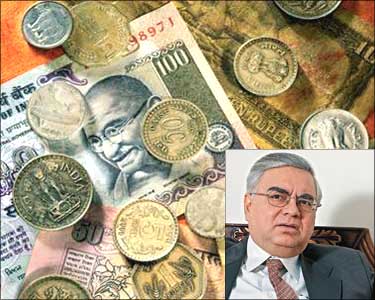
It's a season of change at economic think tanks. In September, Parthasarathi Shome will return to India as chief executive at the Indian Council for Research on International Economic Relations (Icrier), after a 30-month stint with Britain's tax collection agency.
He will join Icrier full-time from December, charting his agenda for the research agency over a five-month period.
During his previous assignment in Delhi, as advisor to P Chidambaram, the then finance minister, Shome was the brain behind introduction of the Fringe Benefit Tax and the Banking Cash Transaction Tax, besides working on the Direct Taxes Code and the Goods & Services Tax. He could not be reached for comment.
Shome will replace Rajiv Kumar, who is moving to Rajiv Gandhi Institute of Contemporary Studies, part of the Rajiv Gandhi Foundation. In the economists' community, Kumar's shift is being seen as a move to revive the institute, which has been headless for some years.
This coincides with Congress general secretary Rahul Gandhi showing greater involvement in its functioning.
...
The National Council for Applied Economic Research (NCAER) is next in line to receive a new director-general. Suman Bery, at the helm of its affairs for nearly a decade, has decided against seeking another term.
And, in 2012, M Govinda Rao's second term as National Institute of Public Finance and Policy (NIPFP) director will also come to an end.
It isn't just a change of faces taking place at some of the think tanks. Over the recent past, their role has also been changing.
For instance, NIPFP, which earlier focused more on advising central and the state governments on taxation, is now venturing into new fields.
For instance, it is advising the Centre on creating a $2-billion pharmaceutical fund. It is also looking at research work on social sector programmes, service delivery, budget management reforms and open-economy macroeconomics.
Similarly, NCAER has hived off its erstwhile consumer research department into a separate entity, which now comes out with reports that are of specific interests to companies.
...

The Energy and Resources Institute (Teri) is planning to evolve on similar lines.
It bid, with 60 others worldwide, for a Kuwaiti government contract to clean the oil spills left by the Iraqi occupation of the country.
Along with a local partner, who has a 40 per cent share, the contract will be implemented by ONGC-Teri Biotech, a joint venture.
The project involves cleaning up an 80x80 km area in Kuwait and is likely to cost around $3 billion, money given by the United Nations to the government of Kuwait.
Teri qualified for the bid on technological grounds, along with a few other organisations, while the decision on its financial qualification is still in progress.
...

Icrier, which earlier primarily focused on trade, is now doing the ground work for the opening of several sectors and the launch of new instruments to diversify their resource base.
"The mandate has not really changed, but definitely there is an increased amount of interaction between the government and think tanks. New issues have also emerged like the G-20 and climate change, which have added to our mandate," says Rajiv Kumar, outgoing director. He did not discuss his plans for RGICS.
The agency had established an endowment fund of Rs 12 crore (Rs 120 million) in 2001, which was increased to Rs 25 crore (Rs 250 million) in 2006.
The endowment fund comprises money from government bodies, the Reserve Bank of India, commercial banks such as State Bank of India and ICICI Bank, as also companies such as ITC. The endowment consists of around 30 per cent of Icrier's budget and the returns are utilised to support long-term research projects.
The remaining 70 per cent of the funds come from research projects that it gets from the government, international organisations and others.
"The idea is that we should not be dependent on any one source of funding to sustain our research activities. Our board members are continuously trying to devise ways to diversify our long-term and short-term funding options," says Isher Judge Ahluwalia, chairperson of the board of governors at Icrier.
...

What prompted the change? Even as policy makers have increased their interactions with the think tanks, the latter see opportunity in corporate India, which is gradually starting to warm up to the analytical reports, forecasts and other research projects being undertaken, say institute functionaries.
This is on the lines of how things have moved in developed countries, where the private sector relies heavily on inputs it gets from think tanks.
Another driving force for the change has been human resource issues. Retaining and attracting research talent to further their mandate as policy advisers has emerged as a big challenge, not just for India Inc but also for the think tanks.
"The booming market for young talent has diverted many potential analysts to the private sector and away from doctoral programmes. In the macroeconomic area, the rise of analysts in commercial and investment banks has intensified the competitive environment," says NCAER's Bery.
The boost to university salaries following the Sixth Pay Commission has also added to the competitive pressure which think tanks have been experiencing.
Spinning off the consumer research department into a new entity has helped NCAER increase its earnings, resulting in better remuneration for research fellows.
While agencies are trying to reinvent themselves, things are not easy.
"Challenges have certainly increased. To be at the cutting edge, think tanks are required to be more pro-active. But then, there are no easy sources of funding," says Govinda Rao.

 © 2025 Rediff.com - Investor Information - Advertise with us - Disclaimer - Privacy Policy - Feedback - About us - Terms of use - Grievances