The suggestion is gaining ground among advisors and experts, given the current global situation, where wheat prices are on the rise on fears of subdued production in drought-hit countries like Russia, Uzbekistan and Kazakhstan.
. . .

Within the government, chief economic advisor Kaushik Basu is also of the view that exporting surplus foodgrain, especially wheat, is a solution to the problem of lack of storage capacity. Basu also believes inflation rate in food articles have constantly been on the rise, in spite of holding food stocks.
. . .
This has boosted the international prices of wheat by around 50 per cent, making it an optimally profitable situation for India to facilitate export of the surplus.
At present, the international wheat price is hovering at around Rs 16,465 a tonne, much above the domestic prices of Rs 11,125 a tonne. The government procurement price of wheat for the current season is Rs 110 a tonne.
. . .
There has already been wastage of around 50,000 tonnes of wheat this year while much more is rotting in open plinths, while the procurement from this season, likely to see a 10.4 per cent growth in harvest, is yet to begin.
Though the kharif crop will mainly consist of paddy, the rabi crop, which will see wheat procurement in February-March next year, will put the government under more stress.
. . .

Both Basu and Gulati point out that the root of the problem is not the lack of storage capacity of government agencies, but the excessive procurement by the government. Gulati says the storage capacity of government agencies is sufficient to store buffer stocks according to buffer norm standards.
. . .
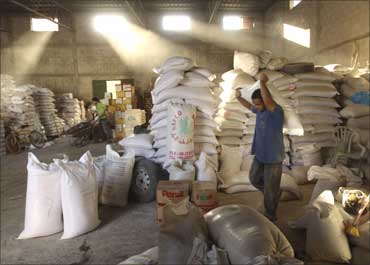
However, the government is currently sitting on 60 million tonnes of foodgrain (as on June 30), around 183 per cent above the minimum buffer stock norm.
"The big question is why they are keeping such huge stock. The private sector has stock limits. However, due to its procurement policies, the government has become the biggest hoarder of foodgrain. This is dictating market prices," Gulati adds.
. . .

Gulati's solution to the entire imbalance in procurement, distribution and storage policy is to export the current surplus and earmark the money generated for creating new storage capacities in the country.
Basu espouses the idea that India can go into swap deals with countries and sell grains in exchange for return sale after two-three years. "The idea is, because you cannot store it here, you store it somewhere else," Basu told Business Standard over the phone.

 © 2025 Rediff.com - Investor Information - Advertise with us - Disclaimer - Privacy Policy - Feedback - About us - Terms of use - Grievances